Parabola Review
KI-AutomatisierungA no-code data automation platform. Build data collection, transformation, and analysis workflows with drag-and-drop.
Fazit der Redaktion
Parabola erhält eine Bewertung von 4/5 und zählt damit zu den leistungsfähigeren Optionen im Bereich ki-automatisierung. Die herausragende Stärke — intuitive visual editor for building data flows — macht das Tool besonders wertvoll, wenn genau diese Fähigkeit für Ihren Workflow entscheidend ist. Der wichtigste Kompromiss ist data processing-focused — not suited for general automation, was Sie vor einer Entscheidung gegen die Alternativen abwägen sollten. Da Sie mit dem kostenlosen Plan ohne Risiko prüfen können, ob das Tool passt, spricht kaum etwas gegen einen ersten Testlauf.
Inhaltsverzeichnis
Was ist Parabola?
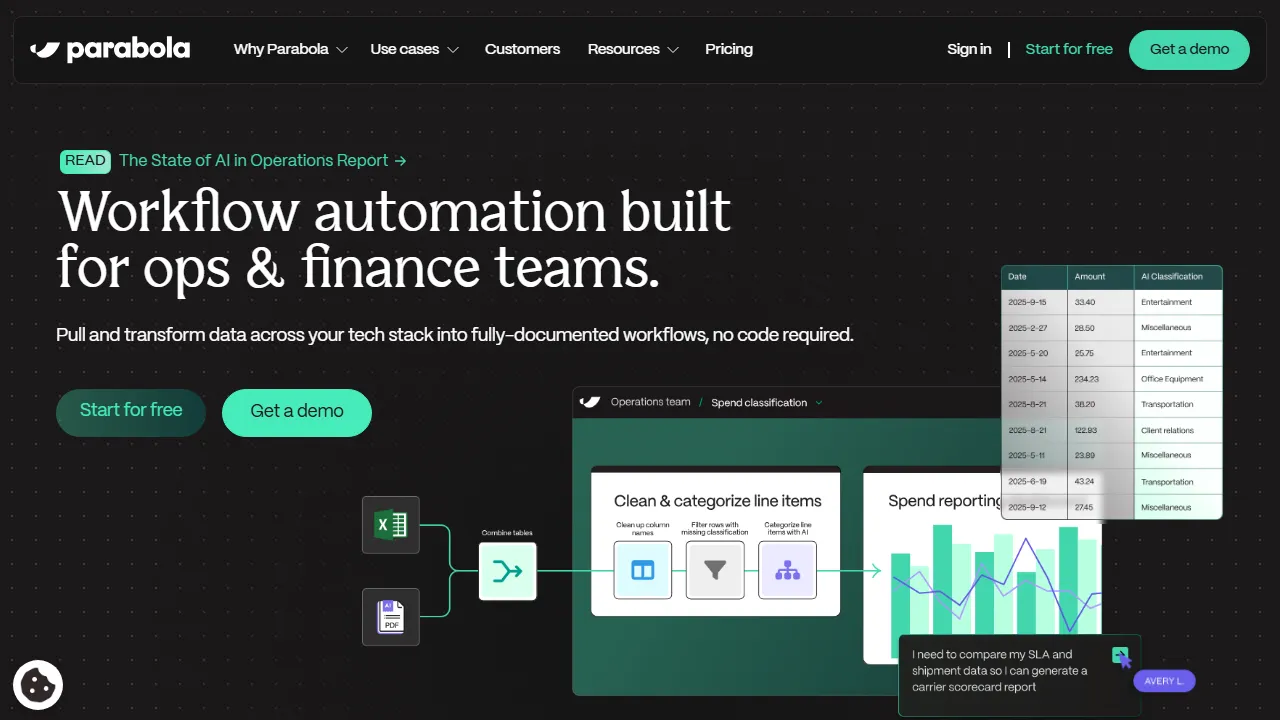
Parabola is a no-code platform that automates data collection, transformation, and analysis. Using its drag-and-drop visual editor, you can import data from diverse sources like Excel, APIs, email, and PDFs, then build advanced operations such as conditional branching, loops, and merges — all without code. Each processing stage displays a real-time preview, so you can verify data transformations step by step as you build your workflow. Its AI capabilities also handle intelligent data extraction from unstructured data sources like PDFs and images. It's especially popular in e-commerce, logistics, and SaaS industries.
Für wen ist Parabola geeignet?
Parabola eignet sich am besten für Operations-Teams und Geschäftsinhaber, die repetitive Workflows optimieren möchten. Der kostenlose Plan senkt die Einstiegshürde und erleichtert eine Evaluierung, bevor Sie sich festlegen. Die breite Funktionspalette (6+) — darunter Visual data flow builder und Real-time data preview — bedeutet, dass Sie für verwandte Aufgaben selten zu einem anderen Tool wechseln müssen. Nutzerinnen und Nutzer heben häufig eine besondere Stärke hervor: intuitive visual editor for building data flows.
Preispläne & Preis-Leistungs-Verhältnis
Parabola bietet folgende Pläne an. Die Preise entsprechen den zuletzt verfügbaren Informationen zum Zeitpunkt des Reviews und können sich ändern. Prüfen Sie vor dem Kauf stets die offizielle Seite.
Hauptfunktionen & Möglichkeiten
Das bietet Parabola — grob sortiert danach, wie zentral jede Funktion für das Produkt-Erlebnis ist.
Vor- und Nachteile
Nach der Bewertung von Parabola im Vergleich zum Rest des Felds im Bereich ki-automatisierung sind dies die Kompromisse, die uns im Alltagseinsatz aufgefallen sind.
Was uns gefallen hat
- ●Intuitive visual editor for building data flows
- ●Real-time preview at each stage lets you verify as you work
- ●AI-powered unstructured data extraction
- ●Integrates with major services like Shopify and Salesforce
- ●Complex data transformations achieved without code
Was besser sein könnte
- ●Data processing-focused — not suited for general automation
- ●Professional plan and above are somewhat expensive
- ●Limited Japanese documentation and support
So starten Sie mit Parabola
Ein praxisorientierter Fünf-Schritte-Weg, den wir allen empfehlen, die Parabola zum ersten Mal testen — ausgelegt darauf, Zeitverschwendung zu vermeiden und eine schnelle Entscheidung zu ermöglichen.
1Bei Parabola registrieren
Rufen Sie die offizielle Parabola-Website auf und erstellen Sie ein Konto. Sie können mit dem kostenlosen Plan starten, ohne Zahlungsdaten einzugeben — ideal, um zu prüfen, wie gut das Tool in Ihren Workflow passt.
2Arbeitsumgebung einrichten
Installieren Sie die App auf web, falls ein nativer Client verfügbar ist, oder öffnen Sie das Tool einfach im Browser. Konfigurieren Sie grundlegende Einstellungen wie Sprache, Benachrichtigungen und Standard-Ausgabestil, damit die folgenden Durchläufe konsistent bleiben.
3Erste Aufgabe mit Visual data flow builder ausführen
Beginnen Sie mit einer kleinen, risikoarmen Aufgabe, um zu verstehen, wie Parabola reagiert. Formulieren Sie einen klaren Prompt oder eine klare Eingabe, prüfen Sie die Ausgabe und iterieren Sie. Diese risikoarme Erkundung ist der schnellste Weg, ein Gefühl dafür zu entwickeln, worin das Tool besonders gut ist.
4In den täglichen Workflow integrieren
Sobald Sie die Stärken kennen, integrieren Sie Parabola in einen konkreten Workflow — nicht in zehn. Ersetzen Sie einen bestehenden Schritt und messen Sie eine Woche lang die gesparte Zeit oder die Qualitätsverbesserung, bevor Sie die Nutzung ausweiten.
5Auf Basis echter Nutzung upgraden
Upgraden Sie nicht vorschnell, sondern beobachten Sie, welche Limits Sie tatsächlich erreichen (Nachrichtenkontingent, Ausgabelänge, Exportfunktionen). Upgraden Sie nur dann, wenn ein konkretes Limit Ihre Produktivität blockiert — nicht weil der höhere Plan auf dem Papier attraktiver aussieht.
Die besten Alternativen zu Parabola
Sie sind unsicher, ob Parabola die richtige Wahl ist? Diese vergleichbaren Tools aus dem Bereich ki-automatisierung lohnen eine Betrachtung — je nach Ihren Prioritäten.
Bardeen AI
A browser extension-based AI automation tool. Automates data collection, form filling, and sales activities with 200+ app integrations.
Bietet eine vergleichbare Redaktionsbewertung bei einem höheren Preis. Am besten geeignet, wenn Sie easy to start automating with a browser extension bevorzugen.
Bardeen
Automate repetitive browser tasks with AI. Streamline web scraping and data entry.
Bietet eine vergleichbare Redaktionsbewertung und einen günstigeren Einstiegspreis. Am besten geeignet, wenn Sie specialized in browser task automation bevorzugen.
Tray.io
Enterprise AI automation platform. Automate complex business processes at scale.
Bietet eine vergleichbare Redaktionsbewertung. Am besten geeignet, wenn Sie 600+ app integrations bevorzugen.
Häufig gestellte Fragen
Can I use Parabola for free?+
Yes, the free plan allows up to 3 flows and 200 steps per month. For more flows and steps, upgrade to the Professional plan ($80/mo).
How does it differ from Zapier?+
Parabola specializes in data transformation and processing, excelling at ETL (Extract/Transform/Load) workflows. Zapier focuses on simple app-to-app integrations (trigger → action).
What industries use it most?+
It's particularly popular in e-commerce (Shopify, etc.), logistics, SaaS, and retail — industries that require heavy data processing. Common use cases include inventory management, order processing, and report automation.
Bereit, Parabola auszuprobieren?
Starten Sie mit dem kostenlosen Plan — keine Kreditkarte erforderlich.
Mit Parabola starten →Weitere KI-Automatisierung
Zapier AI
AI-powered workflow automation platform. Connect over 7,000 apps and achieve advanced business automation with AI.
Make (ehem. Integromat)
A platform that automates workflows with a visual builder. Features AI capabilities with 1,800+ app integrations for building complex automation scenarios.
n8n
An open-source workflow automation tool. Features AI agent capabilities with self-hosting support for complete data control.
Bardeen AI
A browser extension-based AI automation tool. Automates data collection, form filling, and sales activities with 200+ app integrations.
Activepieces
An open-source automation platform. A Zapier alternative offering 330+ integrations and unlimited task execution.
Pipedream
A developer-focused API integration and automation platform. Build flexible workflows combining code execution and no-code actions.
Geprüft von: AIpedia-Redaktion · Zuletzt aktualisiert: 10. Juli 2026 · Methodik: Wie wir testen und bewerten
Dieses Review spiegelt unsere redaktionelle Meinung wider, basierend auf praktischen Tests, einer Preisüberprüfung und einem Abgleich mit der offiziellen Dokumentation. Wir akzeptieren keine Zahlungen für wohlwollende Reviews. Lesen Sie unsere vollständigen Redaktionsrichtlinien.